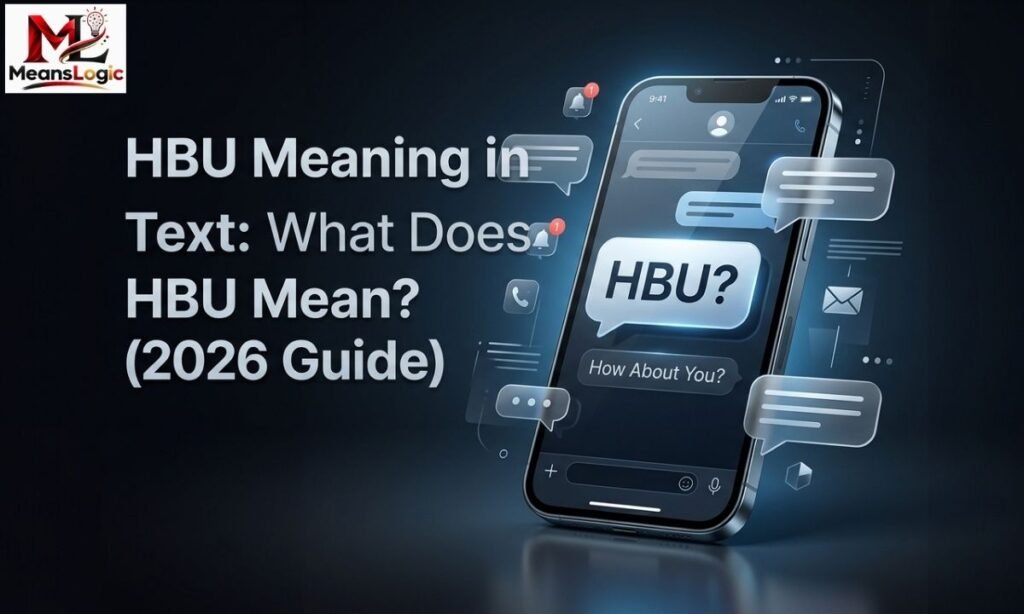
HBU Meaning in Text: What Does HBU Mean? (2026 Guide)

August 28, 2026 HBU Meaning in Text What Does HBU Mean (2026 Guide)

If you’ve ever ended a text with a quick question and gotten “good, hbu?” back, you already have a feel for it but a lot of people still pause the first time they see it out of context. HBU is a tiny texting abbreviation that shows up constantly in chats, DMs, and Snapchat streaks, yet almost nobody explains where it came from or when it’s actually appropriate.

This guide breaks down what HBU means, where it started, how it’s used differently across contexts and platforms like Snapchat, and more importantly when you should reach for a more polished alternative. By the end, you’ll know not just the definition, but how to use it (or skip it) like someone who understands tone.

What Does HBU Mean in Text?
What Does HBU Mean in Text

HBU is short for “How About You?” It’s a quick way to turn a question back on the person you’re texting, usually right after answering something they asked you.

Here’s the simplest example:

Friend: “How was your day?” You: “Pretty good, just tired. HBU?”

That’s the entire function of the abbreviation: it hands the conversational ball back without typing out a full sentence. It’s almost always used at the very end of a message, and it almost always follows an answer to a question, not a fresh topic.

A few quick facts about HBU:

  • Full form: How About You
  • Category: Texting/chat abbreviation, not a formal word
  • Common in: Text messages, DMs, group chats, gaming chats, social media comments
  • Tone: Casual, friendly, low-effort
  • Similar to: WBU (“What About You”) and HAY (“How Are You”)

Other similar quick-reply texting terms include ICL and JS, which show up just as often in everyday chats.

It’s not slang with hidden meaning or a double meaning, it’s simply shorthand. That’s what makes it so widely used: it’s fast, it’s harmless, and everyone already knows what it means.

Where Did “HBU” Come From?

HBU grew out of the same wave of texting abbreviations that gave us BRB, LOL, and TTYL all created in the early days of SMS and instant messaging, when every character counted and typing on a numeric keypad was slow.

Instant messaging platforms like AIM and MSN Messenger popularized this style of clipped, question-based shorthand in the late 1990s and early 2000s. As texting on flip phones took over, abbreviations like HBU stuck around because they saved time without losing meaning.

Read now  IDM Meaning in Text: What It Really Means and How to Use It Correctly

Unlike slang that fades after a few years, HBU never really went out of style it simply moved from AIM chat windows to SMS, then WhatsApp, Instagram DMs, and Snapchat, staying useful because the need it fills (asking “and you?” quickly) never went away.

What Does HBU Mean on Snapchat?

On Snapchat, HBU means exactly the same thing as “How About You?” but it shows up a little differently because of how the platform works.

Snapchat conversations tend to be short, fast-paced, and built around keeping a streak or chat going rather than having a deep conversation. That makes HBU especially common there because:

  • Snaps and chats often replace full sentences with quick check-ins
  • Users want to keep the back-and-forth moving without much typing
  • It pairs naturally with short answers like “nm,” “chillin,” or “same”

A typical Snapchat exchange looks like this:

Them: “wyd” You: “nothing much, just watching tv. hbu” Them: “same lol”

On Snapchat specifically, capitalization is usually dropped entirely (hbu instead of HBU), and punctuation is often skipped too. That’s simply the platform’s casual texting culture, not a different meaning.

HBU Meaning in Text From a Guy
HBU Meaning in Text From a Guy

When a guy sends “hbu,” the meaning doesn’t change but the context often reveals more than the abbreviation itself does. It’s still “How About You?” but the way it’s placed in the conversation can hint at the vibe.

A few common patterns:

  • Casual/friendly: “just got home, hbu?” simple, no deeper meaning, just keeping the chat alive
  • Interested/flirty: “can’t sleep lol, hbu? ” paired with emojis or a playful tone, it can signal he wants the conversation to continue
  • Low-effort/disinterested: A one-word “hbu” with no other context or follow-up questions can sometimes mean he’s replying out of habit rather than genuine interest

The abbreviation itself is neutral. What changes the read is everything around it — response time, emoji use, follow-up questions, and how much effort the rest of the message has.

HBU Meaning in Text From a Boy
HBU Meaning in Text From a Boy

When it comes from a younger texter a teenage boy in a school group chat, for example HBU almost always means exactly what it says, with far less subtext than an adult conversation might carry.

In these contexts, HBU is typically just:

  • A fast way to keep a group chat moving
  • A polite (if minimal) way to ask a friend about their day
  • Standard chat etiquette picked up from friends, without much thought behind it

Reading too much into “hbu” from a middle or high schooler usually overcomplicates something that’s genuinely just quick, casual chatting.

HBU Meaning in Tagalog

HBU isn’t a Filipino or Tagalog term it’s an English texting abbreviation but it’s used very commonly by Tagalog speakers, especially in Taglish (a mix of Tagalog and English) conversations.

In Tagalog-influenced chats, you’ll often see it blended naturally into a sentence, like:

“Okay lang ako, medyo pagod. Hbu, kumusta ka na?” (I’m okay, a bit tired. How about you, how are you?)

The meaning stays identical to English “How About You?” but it’s dropped into Taglish the same way English speakers borrow words from other languages into casual speech. This is common across the Philippines, where switching between English and Tagalog mid-sentence is a normal part of everyday texting.

Read now  What Does “TYSM” Mean? Full Meaning, Usage & Examples

Why “HBU” Can Feel Too Informal

While HBU works perfectly in casual chats, it can feel out of place or even a little careless in certain conversations. A few reasons it can land wrong:

  1. It reads as low-effort. In a conversation that calls for warmth or genuine interest, a bare “hbu” can feel rushed or disengaged.
  2. It’s texting shorthand, not written English. Using it in emails, cover letters, or professional messages breaks the tone instantly.
  3. It can seem dismissive in serious conversations. If someone shares something emotional or important, replying with “hbu” instead of a full response can come across as uninterested.
  4. It’s inconsistent with formal register. Teachers, managers, clients, and older relatives often expect (or simply appreciate) complete sentences.

None of this means HBU is a “bad” word it just has a narrow lane. Knowing when to leave that lane is the real skill.

Casual vs Formal Communication: Why Tone Changes Everything

The same three letters can be perfectly fine in one chat and completely wrong in another. That’s because texting abbreviations like HBU are tone-dependent, not universally acceptable.

SituationIs HBU Appropriate?Better Choice
Texting a close friendYesHBU is fine as-is
Snapchat/Instagram DM with peersYesHBU or “wbu”
Texting a crush or new matchDepends on vibe“What about you?” feels more genuine
Work Slack or emailNo“How about you?” or “And you?”
Messaging a teacher or professorNo“How are you doing?”
Customer service chatNo“How can I help you today?”
Talking to an older relativeDependsSpell it out to avoid confusion

The rule of thumb: the more formal or emotionally important the conversation, the more that abbreviation should be spelled out.

Polite Alternatives to HBU

If you want to keep the same friendly check-in without sounding too casual, there are plenty of natural alternatives:

  • “How about you?”
  • “What about you?”
  • “How are you doing?”
  • “And how’s your day going?”
  • “What’s going on with you?”
  • “How have you been?”
  • “Anything new with you?”

Each of these carries the same intent as HBU turning the question back just with a slightly warmer or more polished tone depending on which one you pick.

Choosing the Right Alternative
Choosing the Right Alternative

Not every alternative fits every situation. Here’s a quick way to decide:

  • For friends and casual chats: Stick with HBU, WBU, or “how about you?” all work fine.
  • For someone you’re getting to know: Use the full phrase “What about you?” shows a little more effort and genuine interest.
  • For coworkers or clients: Go formal “How are you doing today?” or “And yourself?”
  • For older relatives or teachers: Full sentences are safest “How has your day been?”

The goal isn’t to avoid HBU forever it’s to match your response to the relationship and the setting.

Real-World Conversation Examples

Casual friend text:

“Just finished dinner, pretty full lol. hbu?”

Texting a crush:

“Ngl today was actually a good day. What about you how was yours?”

Work Slack message:

“Doing well, thanks for asking! How about you — how’s your week going?”

Messaging a teacher:

“I’m doing well, thank you for asking. How are you doing today?”

Read now  MF Meaning in Social Media Text: What It Stands For and How People Really Use It

Group chat with friends:

“same energy tbh, hbu guys?”

Notice how the structure barely changes only the wording shifts to match who’s on the other end.

Subtle Tone Differences You Shouldn’t Ignore

Small wording choices carry more weight than people expect:

  • “HBU” fast, casual, low-effort, friend-to-friend energy
  • “WBU” nearly identical, just a regional/generational preference
  • “How about you?” neutral, works almost everywhere
  • “What about you?” more personal, often used after someone shares something specific
  • “How are you doing?” warmer, shows more genuine interest
  • “And yourself?” polished, common in professional speech

None of these are “wrong,” but picking the right one shows social awareness reading as more intentional than defaulting to the same abbreviation every time.

Why Variety in Language Makes You Sound Smarter

Relying on the same abbreviation in every conversation regardless of who you’re talking to can flatten the way you come across. Mixing up your phrasing:

  • Shows you’re actually paying attention, not just replying on autopilot
  • Helps conversations feel less repetitive and more engaging
  • Signals emotional intelligence knowing when to be casual and when to dial it up
  • Makes a stronger impression in professional or unfamiliar settings

Think of HBU as one tool in a small toolbox using it well means knowing when to grab a different one instead.

Common Mistakes With “HBU”

  • Using it in professional emails it instantly makes a message look unpolished.
  • Sending a bare “hbu” after something serious it can read as dismissive when more engagement is expected.
  • Overusing it in every reply repeating the same abbreviation constantly makes texting feel robotic.
  • Assuming it always means romantic interest context matters far more than the abbreviation itself.
  • Using it with people unfamiliar with texting slang older relatives or non-native speakers may not recognize it right away.

The Bigger Picture: Digital Communication Slang in 2025

The Bigger Picture Digital Communication Slang in 2025

Texting abbreviations like HBU are part of a much bigger shift in how people communicate. As messaging apps, DMs, and social platforms have replaced phone calls for everyday conversation, shorthand has become the default not because people are lazy, but because fast, low-friction communication fits how we actually talk day to day. This same shift explains why abbreviations like OMY have also become part of everyday texting vocabulary.

At the same time, awareness around tone has grown too. People are increasingly conscious that the same message can land differently depending on wording, punctuation, and even capitalization. That’s why understanding both the shorthand and its formal alternatives rather than picking just one is the more useful skill going into 2026.

HBU Meaning: Understanding HBU and Polite Alternatives for Any Conversation Example

To sum up the practical side of this guide:

  • HBU means “How About You?” nothing more, nothing hidden.
  • It fits casual texting, Snapchat, and friend group chats perfectly.
  • It should generally be avoided in professional, academic, or unfamiliar conversations.
  • Swapping it for a full phrase like “How about you?” or “What about you?” keeps the same intent while matching a more formal tone.
  • The right choice always depends on who you’re talking to, not a fixed rule.

Alternatives to Slang in Professional Writing

Professional writing benefits from spelling things out, even when the intent matches a casual abbreviation. A few swaps worth remembering:

Casual SlangProfessional Alternative
HBUHow about you?
WBUAnd yourself?
TYThank you
ASAPAt your earliest convenience
IDKI’m not certain / I’d need to check
LMKPlease let me know
NPYou’re welcome / Not a problem

The pattern is simple: professional writing favors complete words and slightly more formal phrasing, even when the underlying message stays casual in spirit.

Quick Reference Cheat Sheet

TermMeaningBest Used In
HBUHow About YouTexting, Snapchat, casual DMs
WBUWhat About YouTexting, casual chats
HAYHow Are YouTexting, informal check-ins
“How about you?”Full version of HBUAny setting, safest option
“And yourself?”Polished check-inWork, professional emails

Frequently Asked Questions

Does HBU mean the same thing everywhere?

Yes. Whether it’s a text, Snapchat, or Instagram DM, HBU always means “How About You?”

Is HBU only used by teens?

No. It’s common with teens, but plenty of adults use it too.

Is it rude to reply with just “HBU”?

It can feel a bit cold after a long or emotional message. A fuller reply usually works better.

What’s the difference between HBU and WBU?

Barely any. Both mean “How About You?” WBU is just a common variant.

Can I use HBU in a work email?

It’s best to avoid it. Write “How about you?” instead for a more professional tone.

Final Thoughts

HBU is just a quick way to say “How About You?” It fits perfectly in casual texts and Snapchat chats. It’s simple, friendly, and easy to use.

But it’s not right for every conversation. Save it for friends and casual talks. For work or formal chats, spell it out instead.

Related posts

Determined woman throws darts at target for concept of business success and achieving set goals

HBU Meaning in Text: What Does HBU Mean? (2026 Guide)

August 28, 2026 HBU Meaning in Text What Does HBU Mean (2026 Guide)

If you’ve ever ended a text with a quick question and gotten “good, hbu?” back, you already have a feel for it but a lot of people still pause the first time they see it out of context. HBU is a tiny texting abbreviation that shows up constantly in chats, DMs, and Snapchat streaks, yet almost nobody explains where it came from or when it’s actually appropriate.

This guide breaks down what HBU means, where it started, how it’s used differently across contexts and platforms like Snapchat, and more importantly when you should reach for a more polished alternative. By the end, you’ll know not just the definition, but how to use it (or skip it) like someone who understands tone.

What Does HBU Mean in Text?

What Does HBU Mean in Text

HBU is short for “How About You?” It’s a quick way to turn a question back on the person you’re texting, usually right after answering something they asked you.

Here’s the simplest example:

Friend: “How was your day?” You: “Pretty good, just tired. HBU?”

That’s the entire function of the abbreviation: it hands the conversational ball back without typing out a full sentence. It’s almost always used at the very end of a message, and it almost always follows an answer to a question, not a fresh topic.

A few quick facts about HBU:

  • Full form: How About You
  • Category: Texting/chat abbreviation, not a formal word
  • Common in: Text messages, DMs, group chats, gaming chats, social media comments
  • Tone: Casual, friendly, low-effort
  • Similar to: WBU (“What About You”) and HAY (“How Are You”)

Other similar quick-reply texting terms include ICL and JS, which show up just as often in everyday chats.

It’s not slang with hidden meaning or a double meaning, it’s simply shorthand. That’s what makes it so widely used: it’s fast, it’s harmless, and everyone already knows what it means.

Where Did “HBU” Come From?

HBU grew out of the same wave of texting abbreviations that gave us BRB, LOL, and TTYL all created in the early days of SMS and instant messaging, when every character counted and typing on a numeric keypad was slow.

Instant messaging platforms like AIM and MSN Messenger popularized this style of clipped, question-based shorthand in the late 1990s and early 2000s. As texting on flip phones took over, abbreviations like HBU stuck around because they saved time without losing meaning.

Read now  MF Meaning in Social Media Text: What It Stands For and How People Really Use It

Unlike slang that fades after a few years, HBU never really went out of style it simply moved from AIM chat windows to SMS, then WhatsApp, Instagram DMs, and Snapchat, staying useful because the need it fills (asking “and you?” quickly) never went away.

What Does HBU Mean on Snapchat?

On Snapchat, HBU means exactly the same thing as “How About You?” but it shows up a little differently because of how the platform works.

Snapchat conversations tend to be short, fast-paced, and built around keeping a streak or chat going rather than having a deep conversation. That makes HBU especially common there because:

  • Snaps and chats often replace full sentences with quick check-ins
  • Users want to keep the back-and-forth moving without much typing
  • It pairs naturally with short answers like “nm,” “chillin,” or “same”

A typical Snapchat exchange looks like this:

Them: “wyd” You: “nothing much, just watching tv. hbu” Them: “same lol”

On Snapchat specifically, capitalization is usually dropped entirely (hbu instead of HBU), and punctuation is often skipped too. That’s simply the platform’s casual texting culture, not a different meaning.

HBU Meaning in Text From a Guy

HBU Meaning in Text From a Guy

When a guy sends “hbu,” the meaning doesn’t change but the context often reveals more than the abbreviation itself does. It’s still “How About You?” but the way it’s placed in the conversation can hint at the vibe.

A few common patterns:

  • Casual/friendly: “just got home, hbu?” simple, no deeper meaning, just keeping the chat alive
  • Interested/flirty: “can’t sleep lol, hbu? ” paired with emojis or a playful tone, it can signal he wants the conversation to continue
  • Low-effort/disinterested: A one-word “hbu” with no other context or follow-up questions can sometimes mean he’s replying out of habit rather than genuine interest

The abbreviation itself is neutral. What changes the read is everything around it — response time, emoji use, follow-up questions, and how much effort the rest of the message has.

HBU Meaning in Text From a Boy

HBU Meaning in Text From a Boy

When it comes from a younger texter a teenage boy in a school group chat, for example HBU almost always means exactly what it says, with far less subtext than an adult conversation might carry.

In these contexts, HBU is typically just:

  • A fast way to keep a group chat moving
  • A polite (if minimal) way to ask a friend about their day
  • Standard chat etiquette picked up from friends, without much thought behind it

Reading too much into “hbu” from a middle or high schooler usually overcomplicates something that’s genuinely just quick, casual chatting.

HBU Meaning in Tagalog

HBU isn’t a Filipino or Tagalog term it’s an English texting abbreviation but it’s used very commonly by Tagalog speakers, especially in Taglish (a mix of Tagalog and English) conversations.

In Tagalog-influenced chats, you’ll often see it blended naturally into a sentence, like:

“Okay lang ako, medyo pagod. Hbu, kumusta ka na?” (I’m okay, a bit tired. How about you, how are you?)

The meaning stays identical to English “How About You?” but it’s dropped into Taglish the same way English speakers borrow words from other languages into casual speech. This is common across the Philippines, where switching between English and Tagalog mid-sentence is a normal part of everyday texting.

Read now  MYF Meaning in Text: What It Stands for and How to Use It Right (2026)

Why “HBU” Can Feel Too Informal

While HBU works perfectly in casual chats, it can feel out of place or even a little careless in certain conversations. A few reasons it can land wrong:

  1. It reads as low-effort. In a conversation that calls for warmth or genuine interest, a bare “hbu” can feel rushed or disengaged.
  2. It’s texting shorthand, not written English. Using it in emails, cover letters, or professional messages breaks the tone instantly.
  3. It can seem dismissive in serious conversations. If someone shares something emotional or important, replying with “hbu” instead of a full response can come across as uninterested.
  4. It’s inconsistent with formal register. Teachers, managers, clients, and older relatives often expect (or simply appreciate) complete sentences.

None of this means HBU is a “bad” word it just has a narrow lane. Knowing when to leave that lane is the real skill.

Casual vs Formal Communication: Why Tone Changes Everything

The same three letters can be perfectly fine in one chat and completely wrong in another. That’s because texting abbreviations like HBU are tone-dependent, not universally acceptable.

SituationIs HBU Appropriate?Better Choice
Texting a close friendYesHBU is fine as-is
Snapchat/Instagram DM with peersYesHBU or “wbu”
Texting a crush or new matchDepends on vibe“What about you?” feels more genuine
Work Slack or emailNo“How about you?” or “And you?”
Messaging a teacher or professorNo“How are you doing?”
Customer service chatNo“How can I help you today?”
Talking to an older relativeDependsSpell it out to avoid confusion

The rule of thumb: the more formal or emotionally important the conversation, the more that abbreviation should be spelled out.

Polite Alternatives to HBU

If you want to keep the same friendly check-in without sounding too casual, there are plenty of natural alternatives:

  • “How about you?”
  • “What about you?”
  • “How are you doing?”
  • “And how’s your day going?”
  • “What’s going on with you?”
  • “How have you been?”
  • “Anything new with you?”

Each of these carries the same intent as HBU turning the question back just with a slightly warmer or more polished tone depending on which one you pick.

Choosing the Right Alternative

Choosing the Right Alternative

Not every alternative fits every situation. Here’s a quick way to decide:

  • For friends and casual chats: Stick with HBU, WBU, or “how about you?” all work fine.
  • For someone you’re getting to know: Use the full phrase “What about you?” shows a little more effort and genuine interest.
  • For coworkers or clients: Go formal “How are you doing today?” or “And yourself?”
  • For older relatives or teachers: Full sentences are safest “How has your day been?”

The goal isn’t to avoid HBU forever it’s to match your response to the relationship and the setting.

Real-World Conversation Examples

Casual friend text:

“Just finished dinner, pretty full lol. hbu?”

Texting a crush:

“Ngl today was actually a good day. What about you how was yours?”

Work Slack message:

“Doing well, thanks for asking! How about you — how’s your week going?”

Messaging a teacher:

“I’m doing well, thank you for asking. How are you doing today?”

Read now  IDM Meaning in Text: What It Really Means and How to Use It Correctly

Group chat with friends:

“same energy tbh, hbu guys?”

Notice how the structure barely changes only the wording shifts to match who’s on the other end.

Subtle Tone Differences You Shouldn’t Ignore

Small wording choices carry more weight than people expect:

  • “HBU” fast, casual, low-effort, friend-to-friend energy
  • “WBU” nearly identical, just a regional/generational preference
  • “How about you?” neutral, works almost everywhere
  • “What about you?” more personal, often used after someone shares something specific
  • “How are you doing?” warmer, shows more genuine interest
  • “And yourself?” polished, common in professional speech

None of these are “wrong,” but picking the right one shows social awareness reading as more intentional than defaulting to the same abbreviation every time.

Why Variety in Language Makes You Sound Smarter

Relying on the same abbreviation in every conversation regardless of who you’re talking to can flatten the way you come across. Mixing up your phrasing:

  • Shows you’re actually paying attention, not just replying on autopilot
  • Helps conversations feel less repetitive and more engaging
  • Signals emotional intelligence knowing when to be casual and when to dial it up
  • Makes a stronger impression in professional or unfamiliar settings

Think of HBU as one tool in a small toolbox using it well means knowing when to grab a different one instead.

Common Mistakes With “HBU”

  • Using it in professional emails it instantly makes a message look unpolished.
  • Sending a bare “hbu” after something serious it can read as dismissive when more engagement is expected.
  • Overusing it in every reply repeating the same abbreviation constantly makes texting feel robotic.
  • Assuming it always means romantic interest context matters far more than the abbreviation itself.
  • Using it with people unfamiliar with texting slang older relatives or non-native speakers may not recognize it right away.

The Bigger Picture: Digital Communication Slang in 2025

The Bigger Picture Digital Communication Slang in 2025

Texting abbreviations like HBU are part of a much bigger shift in how people communicate. As messaging apps, DMs, and social platforms have replaced phone calls for everyday conversation, shorthand has become the default not because people are lazy, but because fast, low-friction communication fits how we actually talk day to day. This same shift explains why abbreviations like OMY have also become part of everyday texting vocabulary.

At the same time, awareness around tone has grown too. People are increasingly conscious that the same message can land differently depending on wording, punctuation, and even capitalization. That’s why understanding both the shorthand and its formal alternatives rather than picking just one is the more useful skill going into 2026.

HBU Meaning: Understanding HBU and Polite Alternatives for Any Conversation Example

To sum up the practical side of this guide:

  • HBU means “How About You?” nothing more, nothing hidden.
  • It fits casual texting, Snapchat, and friend group chats perfectly.
  • It should generally be avoided in professional, academic, or unfamiliar conversations.
  • Swapping it for a full phrase like “How about you?” or “What about you?” keeps the same intent while matching a more formal tone.
  • The right choice always depends on who you’re talking to, not a fixed rule.

Alternatives to Slang in Professional Writing

Professional writing benefits from spelling things out, even when the intent matches a casual abbreviation. A few swaps worth remembering:

Casual SlangProfessional Alternative
HBUHow about you?
WBUAnd yourself?
TYThank you
ASAPAt your earliest convenience
IDKI’m not certain / I’d need to check
LMKPlease let me know
NPYou’re welcome / Not a problem

The pattern is simple: professional writing favors complete words and slightly more formal phrasing, even when the underlying message stays casual in spirit.

Quick Reference Cheat Sheet

TermMeaningBest Used In
HBUHow About YouTexting, Snapchat, casual DMs
WBUWhat About YouTexting, casual chats
HAYHow Are YouTexting, informal check-ins
“How about you?”Full version of HBUAny setting, safest option
“And yourself?”Polished check-inWork, professional emails

Frequently Asked Questions

Does HBU mean the same thing everywhere?

Yes. Whether it’s a text, Snapchat, or Instagram DM, HBU always means “How About You?”

Is HBU only used by teens?

No. It’s common with teens, but plenty of adults use it too.

Is it rude to reply with just “HBU”?

It can feel a bit cold after a long or emotional message. A fuller reply usually works better.

What’s the difference between HBU and WBU?

Barely any. Both mean “How About You?” WBU is just a common variant.

Can I use HBU in a work email?

It’s best to avoid it. Write “How about you?” instead for a more professional tone.

Final Thoughts

HBU is just a quick way to say “How About You?” It fits perfectly in casual texts and Snapchat chats. It’s simple, friendly, and easy to use.

But it’s not right for every conversation. Save it for friends and casual talks. For work or formal chats, spell it out instead.

Related posts

Determined woman throws darts at target for concept of business success and achieving set goals

3 thoughts on “HBU Meaning in Text: What Does HBU Mean? (2026 Guide)”

Leave a Comment