IDM Meaning in Text: What It Really Means and How to Use It Correctly

September 1, 2026 IDM Meaning in Text What It Really Means and How to Use It Correctly

If you’ve spotted “IDM” in a text message, group chat, or Instagram DM and paused to figure out what it means, you’re not alone. Texting slang moves fast, and abbreviations like this one pop up in casual conversations every day, often without any explanation.

In most cases, IDM means “I Don’t Mind.” It’s a quick, relaxed way to show agreement or flexibility without typing a full sentence. This guide breaks down the real meaning of IDM, where it comes from, how people actually use it, and how to avoid the common mix-ups that trip people up.

What Does IDM Mean in Text?

In texting, IDM stands for “I Don’t Mind.” It’s used when someone is okay with a choice, plan, or suggestion and doesn’t have a strong opinion either way.

Instead of typing out a full response, people shorten it to three letters to keep the conversation moving. For example:

  • Friend: “Coffee or tea?”
  • You: “IDM.”

Here, IDM simply tells the other person that either option works for you. It’s neutral, easygoing, and doesn’t lean toward one choice over another.

Why Is IDM Popular in Texting?

Texting favors speed over grammar, and IDM fits that habit perfectly. It saves time, avoids overthinking a reply, and still gets the point across clearly.

A few reasons IDM has stuck around in everyday chats:

  • It’s short and easy to type on a phone keyboard.
  • It sounds friendly rather than dismissive.
  • It works in almost any casual conversation.
  • It avoids sounding indecisive while still leaving room for someone else to choose.
Read now  TS PMO Meaning: What It Really Means in Text Messages

Because it fits so naturally into fast-paced digital conversations, IDM has become a regular part of texting vocabulary across age groups.

What Does Idm Mean in Text Message?
What Does Idm Mean in Text Message

When IDM shows up in a single text message, it almost always carries the same core meaning: the sender is fine with whatever is being discussed. It’s commonly used as a one-word reply to a question that offers two or more choices.

For instance:

  • “Should we leave now or in 10 minutes?”
  • “idm”

This tells the other person you’re comfortable either way, without needing a longer explanation.

Idm Full Form in Chat

The full form of IDM in chat is straightforward:

IDM = I Don’t Mind

Unlike some internet acronyms that shift meaning depending on the app, IDM’s full form stays consistent across texting platforms, WhatsApp, Instagram, Snapchat, and Discord. The tone might change slightly depending on context, but the underlying meaning rarely does.

What does idm mean on instagram?

On Instagram, IDM keeps the same meaning as in regular texting: “I Don’t Mind.” You’ll often see it in comments, story replies, or direct messages when someone is responding casually to a suggestion.

Common Instagram examples include:

  • Replying to a poll sticker with “idm, either is fine.”
  • Responding to a DM asking, “Should I post this pic?” with “idm.”
  • Commenting on a friend’s post to show casual agreement.

Because Instagram conversations tend to be quick and informal, IDM fits naturally into that style of communication. It’s the same spirit behind other casual replies like MF in social media text, where brevity matters more than full sentences.

How IDM Is Used in Everyday Conversations

IDM shows up most often when someone is asked to pick between two or more options, or when they’re being asked for permission. It’s a low-effort way to signal that you’re going along with whatever is decided.

Typical everyday uses include:

  • Choosing between food, movies, or plans.
  • Agreeing to a change in schedule.
  • Giving casual permission for something.
  • Responding to group chat decisions without pushing a personal preference.

In all of these situations, IDM keeps the reply short while still being clear and polite.

Different Contexts Where IDM Appears
Different Contexts Where IDM Appears

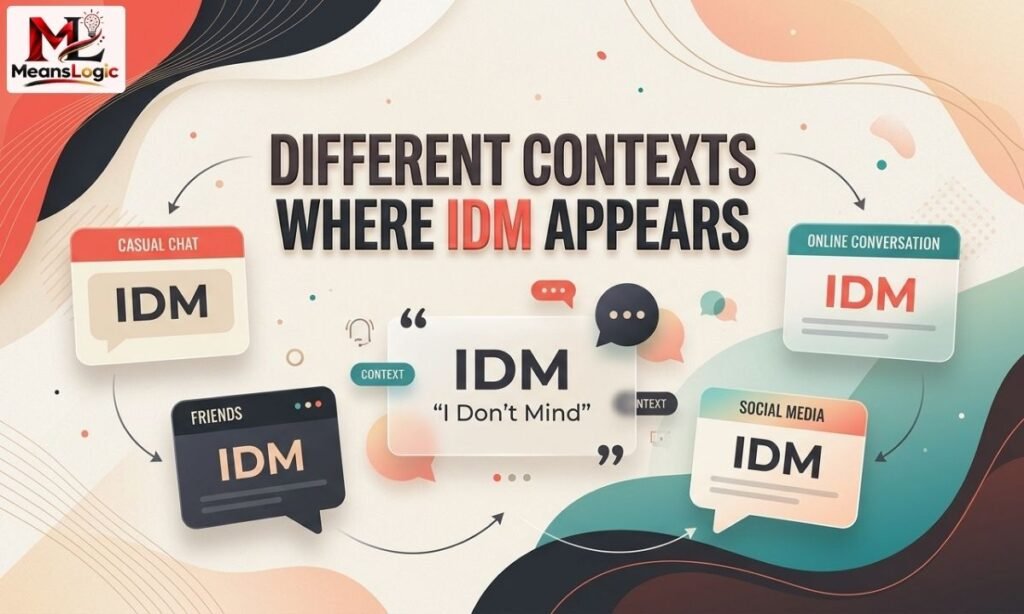
While the meaning of IDM stays fairly consistent, the setting it appears in can shape how it feels. Here’s how it typically plays out across different platforms:

ContextHow IDM Is Used
Texting with friendsCasual agreement to plans or choices
Group chatsQuick response when multiple people are deciding something
Instagram/SnapchatReply to DMs, story polls, or comments
Gaming chatsFast coordination between teammates
Workplace chatsRare, but used in informal team messaging

Understanding the setting helps you read the tone behind the abbreviation more accurately.

Read now  THB Meaning in Text: What “THB” Really Means in Messages, Social Media, and Online Chats

Less Common Meanings of IDM

Although “I Don’t Mind” is the dominant meaning, IDM occasionally stands for something else depending on the situation:

  • Internet Download Manager a well-known software tool, especially in tech-related conversations.
  • Indirect Message occasionally used informally on some platforms.
  • Individual/Idiosyncratic usage rare, personal shorthand used within specific friend groups.

These meanings are far less common than the texting slang version, so context is key when deciding which one applies.

How to Tell Which Meaning of IDM Is Intended?

Since IDM can technically mean more than one thing, a quick context check helps avoid confusion:

  • If it appears in a casual text or DM replying to a question, it almost certainly means “I don’t mind.”
  • If it shows up in a tech forum or software discussion, it likely refers to Internet Download Manager.
  • If the surrounding message references downloading files or software tools, that’s a strong clue too.

In everyday personal texting, the slang meaning applies well over 90% of the time.

Common Misunderstandings About IDM

A few mix-ups happen regularly with this abbreviation:

  • Assuming it sounds rude or dismissive. In reality, IDM is usually friendly and open, not cold.
  • Confusing it with IDK (“I don’t know”). These have completely different meanings.
  • Reading indifference as disinterest. IDM shows flexibility, not a lack of care.

Because tone doesn’t always translate well in text, some readers misread short replies like IDM as distant, even when that’s not the sender’s intention. This is similar to how THB can come across as blunt if the reader misses the honest intent behind it.

Is IDM Formal or Informal?

IDM is strictly informal. It belongs in casual texting, social media, and relaxed group chats rather than professional or formal writing.

It’s best avoided in:

  • Emails to clients or colleagues
  • Formal reports or documents
  • First-time professional conversations

In casual workplace chats among close coworkers, it may occasionally appear, but a full sentence is usually the safer choice in professional settings.

Alternatives to IDM in Texting

If you want to express the same idea with a slightly different tone, several alternatives work well:

  • “I’m okay with either.”
  • “Whatever works for you.”
  • “No preference here.”
  • “Sounds good either way.”
  • “NP” (no problem), when responding to an apology rather than a choice.
Read now  WYF Meaning: The Real Definition, Context, and How to Use It Correctly in Text and Social Media

These alternatives can add warmth or clarity when a one-word reply feels too short for the moment.

IDM vs Similar Text Acronyms

IDM is often confused with other short texting abbreviations. Here’s how it compares:

AcronymMeaningTypical Tone
IDMI don’t mindNeutral, flexible
IDCI don’t careCan sound blunt or dismissive
IDKI don’t knowUncertain, not decision-related
NPNo problemReassuring, positive
OKAgreementNeutral, simple confirmation

The key difference is tone: IDM tends to sound more considerate than IDC, even though both suggest a lack of strong preference.

When You Should Avoid Using IDM

There are moments when IDM isn’t the right choice, even in casual chats:

  • When someone needs a clear decision rather than flexibility.
  • In professional or formal communication.
  • When the topic is serious or emotionally sensitive.
  • When clarity matters more than brevity, such as confirming plans with strict timing.

In these situations, spelling out your response avoids any risk of being misread.

Why Understanding IDM Matters?

Knowing what IDM means helps you respond appropriately and avoid awkward misunderstandings. Texting relies heavily on shorthand, and misreading a simple abbreviation can lead to confusion about someone’s actual intent.

Being familiar with common slang like IDM also makes it easier to follow fast-moving conversations, especially in group chats or on social media, where quick replies are the norm rather than the exception.

Examples of Correct and Incorrect Usage

Correct usage:

  • “Movie tonight or tomorrow?” → “IDM, you pick.”
  • “Can I tag you in this photo?” → “idm, go ahead.”

Incorrect or unclear usage:

  • Using IDM to answer a question that requires specific information, such as “What time works for you?” A vague “IDM” here isn’t helpful. In cases like this, a quick HBU follow-up question often works better than a flat IDM.
  • Using IDM in a formal email, which can come across as unprofessional.

Matching the abbreviation to the right situation keeps communication clear.

How IDM Reflects Modern Communication Trends
How IDM Reflects Modern Communication Trends

The popularity of IDM reflects a broader shift toward efficient, low-pressure digital communication. People increasingly favor short, flexible replies that keep conversations light and fast, especially in messaging apps built around quick exchanges.

Abbreviations like IDM show how everyday language adapts to new communication habits, prioritizing speed and casual tone without losing meaning.

Frequently Asked Questions

What does IDM mean in a text message? 

IDM usually means “I Don’t Mind,” showing that someone is okay with a choice or suggestion.

Is IDM the same as IDC? 

No. IDM (“I don’t mind”) sounds more considerate, while IDC (“I don’t care”) can feel more dismissive.

Can IDM mean something other than “I don’t mind”? 

Yes, in tech contexts it can refer to Internet Download Manager, though this is far less common in texting.

Is it okay to use IDM in professional messages? 

It’s best avoided in formal or professional communication since it’s considered casual slang.

Does IDM sound rude? 

Not typically. It’s generally viewed as a neutral, friendly response rather than a dismissive one.

Final Thoughts

IDM is a simple, widely used texting abbreviation that almost always means “I Don’t Mind.” It signals flexibility and ease rather than indifference, making it a natural fit for casual texting, group chats, and social media replies.

Understanding the context it appears in, whether that’s a friendly DM or a rare tech-related mention, makes it easier to read the intended meaning correctly and respond in a way that matches the conversation.

Related posts

Determined woman throws darts at target for concept of business success and achieving set goals

IDM Meaning in Text: What It Really Means and How to Use It Correctly

September 1, 2026 IDM Meaning in Text What It Really Means and How to Use It Correctly

If you’ve spotted “IDM” in a text message, group chat, or Instagram DM and paused to figure out what it means, you’re not alone. Texting slang moves fast, and abbreviations like this one pop up in casual conversations every day, often without any explanation.

In most cases, IDM means “I Don’t Mind.” It’s a quick, relaxed way to show agreement or flexibility without typing a full sentence. This guide breaks down the real meaning of IDM, where it comes from, how people actually use it, and how to avoid the common mix-ups that trip people up.

What Does IDM Mean in Text?

In texting, IDM stands for “I Don’t Mind.” It’s used when someone is okay with a choice, plan, or suggestion and doesn’t have a strong opinion either way.

Instead of typing out a full response, people shorten it to three letters to keep the conversation moving. For example:

  • Friend: “Coffee or tea?”
  • You: “IDM.”

Here, IDM simply tells the other person that either option works for you. It’s neutral, easygoing, and doesn’t lean toward one choice over another.

Why Is IDM Popular in Texting?

Texting favors speed over grammar, and IDM fits that habit perfectly. It saves time, avoids overthinking a reply, and still gets the point across clearly.

A few reasons IDM has stuck around in everyday chats:

  • It’s short and easy to type on a phone keyboard.
  • It sounds friendly rather than dismissive.
  • It works in almost any casual conversation.
  • It avoids sounding indecisive while still leaving room for someone else to choose.
Read now  THB Meaning in Text: What “THB” Really Means in Messages, Social Media, and Online Chats

Because it fits so naturally into fast-paced digital conversations, IDM has become a regular part of texting vocabulary across age groups.

What Does Idm Mean in Text Message?

What Does Idm Mean in Text Message

When IDM shows up in a single text message, it almost always carries the same core meaning: the sender is fine with whatever is being discussed. It’s commonly used as a one-word reply to a question that offers two or more choices.

For instance:

  • “Should we leave now or in 10 minutes?”
  • “idm”

This tells the other person you’re comfortable either way, without needing a longer explanation.

Idm Full Form in Chat

The full form of IDM in chat is straightforward:

IDM = I Don’t Mind

Unlike some internet acronyms that shift meaning depending on the app, IDM’s full form stays consistent across texting platforms, WhatsApp, Instagram, Snapchat, and Discord. The tone might change slightly depending on context, but the underlying meaning rarely does.

What does idm mean on instagram?

On Instagram, IDM keeps the same meaning as in regular texting: “I Don’t Mind.” You’ll often see it in comments, story replies, or direct messages when someone is responding casually to a suggestion.

Common Instagram examples include:

  • Replying to a poll sticker with “idm, either is fine.”
  • Responding to a DM asking, “Should I post this pic?” with “idm.”
  • Commenting on a friend’s post to show casual agreement.

Because Instagram conversations tend to be quick and informal, IDM fits naturally into that style of communication. It’s the same spirit behind other casual replies like MF in social media text, where brevity matters more than full sentences.

How IDM Is Used in Everyday Conversations

IDM shows up most often when someone is asked to pick between two or more options, or when they’re being asked for permission. It’s a low-effort way to signal that you’re going along with whatever is decided.

Typical everyday uses include:

  • Choosing between food, movies, or plans.
  • Agreeing to a change in schedule.
  • Giving casual permission for something.
  • Responding to group chat decisions without pushing a personal preference.

In all of these situations, IDM keeps the reply short while still being clear and polite.

Different Contexts Where IDM Appears

Different Contexts Where IDM Appears

While the meaning of IDM stays fairly consistent, the setting it appears in can shape how it feels. Here’s how it typically plays out across different platforms:

ContextHow IDM Is Used
Texting with friendsCasual agreement to plans or choices
Group chatsQuick response when multiple people are deciding something
Instagram/SnapchatReply to DMs, story polls, or comments
Gaming chatsFast coordination between teammates
Workplace chatsRare, but used in informal team messaging

Understanding the setting helps you read the tone behind the abbreviation more accurately.

Read now  JS Meaning in Text (2026): What It Really Means and How to Use It Right

Less Common Meanings of IDM

Although “I Don’t Mind” is the dominant meaning, IDM occasionally stands for something else depending on the situation:

  • Internet Download Manager a well-known software tool, especially in tech-related conversations.
  • Indirect Message occasionally used informally on some platforms.
  • Individual/Idiosyncratic usage rare, personal shorthand used within specific friend groups.

These meanings are far less common than the texting slang version, so context is key when deciding which one applies.

How to Tell Which Meaning of IDM Is Intended?

Since IDM can technically mean more than one thing, a quick context check helps avoid confusion:

  • If it appears in a casual text or DM replying to a question, it almost certainly means “I don’t mind.”
  • If it shows up in a tech forum or software discussion, it likely refers to Internet Download Manager.
  • If the surrounding message references downloading files or software tools, that’s a strong clue too.

In everyday personal texting, the slang meaning applies well over 90% of the time.

Common Misunderstandings About IDM

A few mix-ups happen regularly with this abbreviation:

  • Assuming it sounds rude or dismissive. In reality, IDM is usually friendly and open, not cold.
  • Confusing it with IDK (“I don’t know”). These have completely different meanings.
  • Reading indifference as disinterest. IDM shows flexibility, not a lack of care.

Because tone doesn’t always translate well in text, some readers misread short replies like IDM as distant, even when that’s not the sender’s intention. This is similar to how THB can come across as blunt if the reader misses the honest intent behind it.

Is IDM Formal or Informal?

IDM is strictly informal. It belongs in casual texting, social media, and relaxed group chats rather than professional or formal writing.

It’s best avoided in:

  • Emails to clients or colleagues
  • Formal reports or documents
  • First-time professional conversations

In casual workplace chats among close coworkers, it may occasionally appear, but a full sentence is usually the safer choice in professional settings.

Alternatives to IDM in Texting

If you want to express the same idea with a slightly different tone, several alternatives work well:

  • “I’m okay with either.”
  • “Whatever works for you.”
  • “No preference here.”
  • “Sounds good either way.”
  • “NP” (no problem), when responding to an apology rather than a choice.
Read now  What Does OMY Mean? OMY Meaning in Text and Chat (2026)

These alternatives can add warmth or clarity when a one-word reply feels too short for the moment.

IDM vs Similar Text Acronyms

IDM is often confused with other short texting abbreviations. Here’s how it compares:

AcronymMeaningTypical Tone
IDMI don’t mindNeutral, flexible
IDCI don’t careCan sound blunt or dismissive
IDKI don’t knowUncertain, not decision-related
NPNo problemReassuring, positive
OKAgreementNeutral, simple confirmation

The key difference is tone: IDM tends to sound more considerate than IDC, even though both suggest a lack of strong preference.

When You Should Avoid Using IDM

There are moments when IDM isn’t the right choice, even in casual chats:

  • When someone needs a clear decision rather than flexibility.
  • In professional or formal communication.
  • When the topic is serious or emotionally sensitive.
  • When clarity matters more than brevity, such as confirming plans with strict timing.

In these situations, spelling out your response avoids any risk of being misread.

Why Understanding IDM Matters?

Knowing what IDM means helps you respond appropriately and avoid awkward misunderstandings. Texting relies heavily on shorthand, and misreading a simple abbreviation can lead to confusion about someone’s actual intent.

Being familiar with common slang like IDM also makes it easier to follow fast-moving conversations, especially in group chats or on social media, where quick replies are the norm rather than the exception.

Examples of Correct and Incorrect Usage

Correct usage:

  • “Movie tonight or tomorrow?” → “IDM, you pick.”
  • “Can I tag you in this photo?” → “idm, go ahead.”

Incorrect or unclear usage:

  • Using IDM to answer a question that requires specific information, such as “What time works for you?” A vague “IDM” here isn’t helpful. In cases like this, a quick HBU follow-up question often works better than a flat IDM.
  • Using IDM in a formal email, which can come across as unprofessional.

Matching the abbreviation to the right situation keeps communication clear.

How IDM Reflects Modern Communication Trends

How IDM Reflects Modern Communication Trends

The popularity of IDM reflects a broader shift toward efficient, low-pressure digital communication. People increasingly favor short, flexible replies that keep conversations light and fast, especially in messaging apps built around quick exchanges.

Abbreviations like IDM show how everyday language adapts to new communication habits, prioritizing speed and casual tone without losing meaning.

Frequently Asked Questions

What does IDM mean in a text message? 

IDM usually means “I Don’t Mind,” showing that someone is okay with a choice or suggestion.

Is IDM the same as IDC? 

No. IDM (“I don’t mind”) sounds more considerate, while IDC (“I don’t care”) can feel more dismissive.

Can IDM mean something other than “I don’t mind”? 

Yes, in tech contexts it can refer to Internet Download Manager, though this is far less common in texting.

Is it okay to use IDM in professional messages? 

It’s best avoided in formal or professional communication since it’s considered casual slang.

Does IDM sound rude? 

Not typically. It’s generally viewed as a neutral, friendly response rather than a dismissive one.

Final Thoughts

IDM is a simple, widely used texting abbreviation that almost always means “I Don’t Mind.” It signals flexibility and ease rather than indifference, making it a natural fit for casual texting, group chats, and social media replies.

Understanding the context it appears in, whether that’s a friendly DM or a rare tech-related mention, makes it easier to read the intended meaning correctly and respond in a way that matches the conversation.

Related posts

Determined woman throws darts at target for concept of business success and achieving set goals

1 thought on “IDM Meaning in Text: What It Really Means and How to Use It Correctly”

Leave a Comment